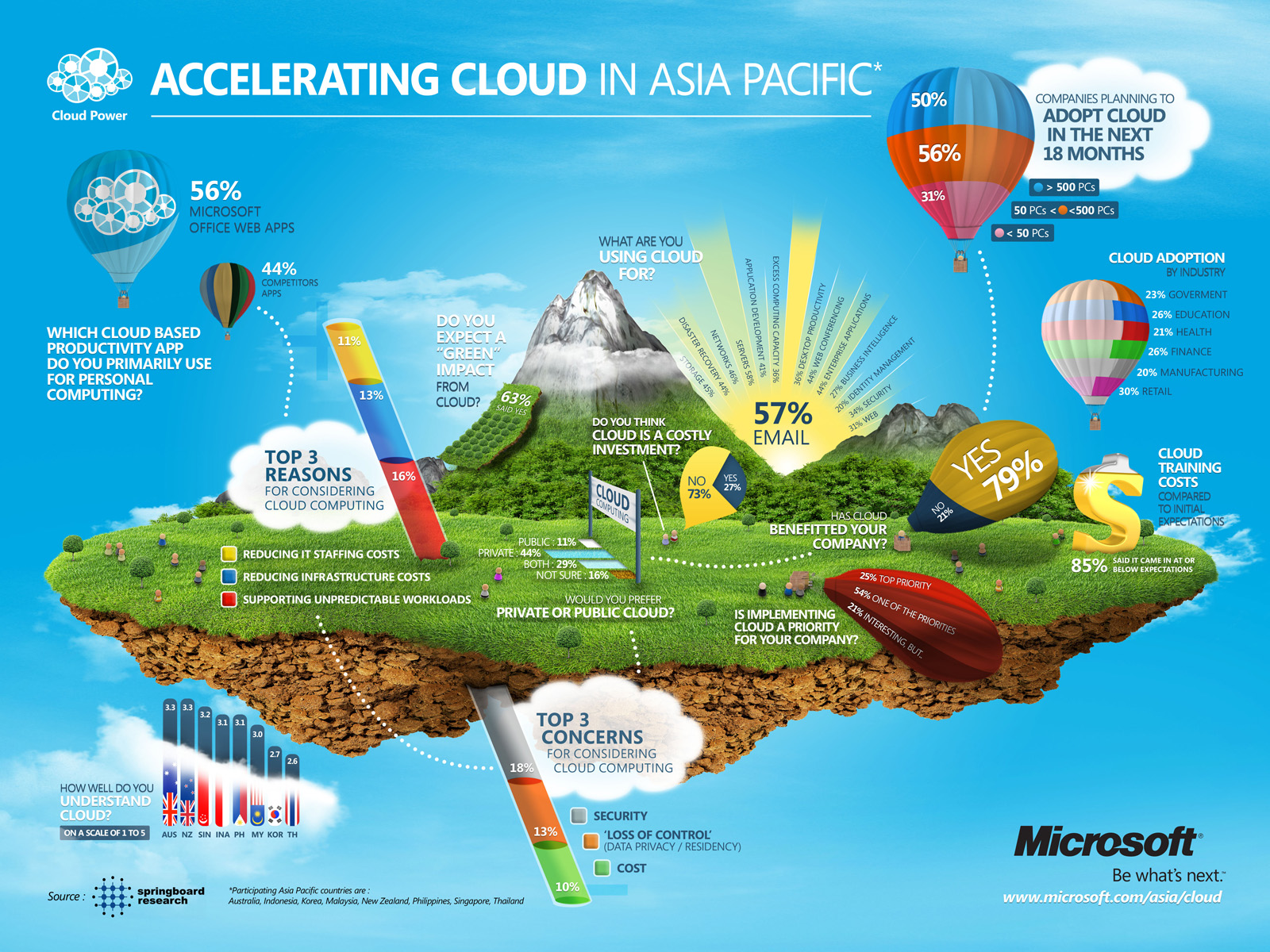
Who knew hot air balloons was the preferred method of transportation in Asia Pacific? I demand all future Microsoft reports to be presented in a similar style.
Who knew hot air balloons was the preferred method of transportation in Asia Pacific? I demand all future Microsoft reports to be presented in a similar style.
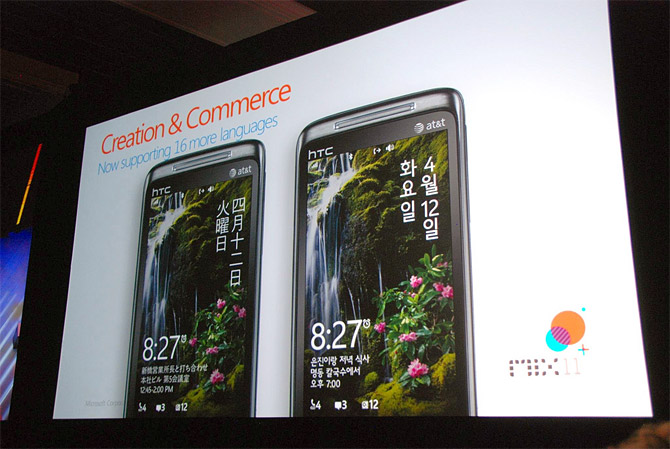
During MIX11 last month, Microsoft announced they would introduce support for an additional 16 languages in Windows Phone 7 “Mango” including the highly anticipated East Asian languages including but not limited to Chinese, Japanese and Korean. Shortly afterwards I learned about some additional tidbits that I forgot to write about, so here it is, better late than never.
As illustrated on the keynote slide above, East Asian support is not only the introduction of a new character set but actually a slightly modified implementation of the Metro design language.
To accommodate the bigger size of character-based writing, the Windows Phone design team is adopting a vertical text layout to reduce the amount of text clipping that would occur more frequently (than it already does). The vertical text will not be limited to just the date and time on the lock screen but will also be featured in hubs (panoramas) and other native apps.
Unfortunately for third-party developers and designers, Microsoft had indicated the vertical layout will not be automatically available to third-party applications. Of course I presume there will be nothing to stop apps from emulating the look, just these layouts probably won’t be supported in the native panorama templates that ship with the official SDK.
Furthermore, it wouldn’t be surprising if these East Asian changes is part of a broader Metro refresh for Mango as well. After all, in a meeting with the Windows Phone design team shortly after WP7’s launch, they had already indicated they were hard at work on the evolution of Metro.
This is cross posted from the MetroTwit blog.
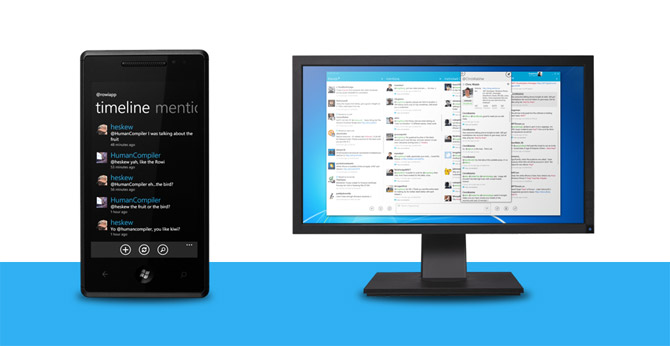
Since we launched MetroTwit those months ago, one of the most common feedback we’ve heard is “MetroTwit is great on Windows, do you have a Windows Phone 7 app?”. Of course, we share the same need with our users to access Twitter on a range of platforms which is why we’re proud to announce “The Nest” partnership with Rowi.
Not long ago, many of us fell in love with Rowi for Windows Phone 7. In many ways, it reminded us of MetroTwit and our own design goals. Soon after opening a dialog with Rowi’s developers, we knew it would be far more beneficial for us and our users to enjoy full-featured applications on each platform, with the synergy often found in cross-platform applications.
Over the past few days, we’ve been designing “The Nest“, a cloud-based backend that will support the syncing of configuration and state data across clients (the first of its kind we believe). In the first version we’ll be focusing on column configurations and the unread tweet state.
An additional feature of the system is that it can also work as a backup service for individual clients, saving the state if the user should use multiple installations or reinstall the software.
We hope to deliver “The Nest” support very soon with the next updates of both MetroTwit and Rowi making it easier to keep up with Twitter at the PC and on the go.
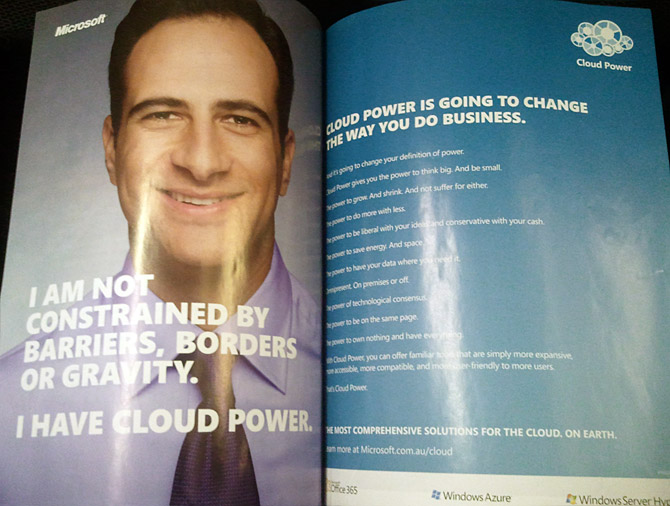
Sorry for the poor photo but I saw this double-spread ad for Microsoft’s “Cloud Power” campaign in a Qantas inflight magazine of all places. As you can see, the laws of physics no longer apply when you have cloud power. Better start planning my hover car with Office 365.
As a country with it’s fair share of inventions, it’s fitting Microsoft’s annual worldwide student technology competition, the “Imagine Cup“, is going leave it’s mark in down under next year as Microsoft Australia announced today it had won the bid to host the 2012 competition finals in Sydney.
At a press event in the Powerhouse Museum, fitting as a celebration of innovation, Microsoft Australia made the announcement with the support of many notable Australians including Peter Garrett, Minister for Education; Jessica Watson, the youngest person to sail around the world solo; Fiona Wood, inventor of spray on skin.
As a previous first-prize winner in the software design category, believe me when I say the competition is a much bigger deal than it might appear from the outside. With more than 325,000 registered competitors representing 100 countries in 2010, competing for just a little under $250,000 of prize money in the handful of categories, it’s a unique and life changing experience for technology students.
If the scale and intensity of the competition wasn’t enough, Microsoft spices it up with a new location every year. Chronologically, the competition has been held in Barcelona, Sao Pauolo, Yokohama, Delhi, Seoul, Paris, Cario and Warsaw. In a couple months, 2011’s finals will be held in New York City.
For Imagine Cup’s 10th anniversary, it will come to the majestic harbor city of Sydney, just before the end of the world. Below is a quick promo video for Imagine Cup 2012, which may or may not feature yours truly.
Some of you might know I was part of the Australian team in 2008 taking out first prize in the Microsoft Imagine Cup student software design competition. Well, it’s that time of the year again where local competitions are happening all around the world and this Thursday (5th of May) in Sydney is the Australian finals and you’re all invited.
From 3.45pm at the science and design Powerhouse Museum, five Australian finalist university teams will compete for the first prize to also participate at the worldwide finals in New York City early July. Each team will make a 20 minute presentation and 10 minutes of Q&A, with the winners announced at 7pm and a short celebration party afterwards with drinks.
If you don’t have anything planned Thursday afternoon, register to attend the free event here. There’s also door prizes up for grabs including XBOX 360 Kinect bundles and games. I’ll be there.