All posts by Long Zheng

Aussie HTC HD7 WP7 bonus: two free XBOX360 games

For Australians, there’s a new Windows Phone 7 device in town and quite a sweet treat from Microsoft Australia to go along with it.

Even though Optus’ Samsung Omnia 7 is hands-down the best Windows Phone 7 device available down under, if your choice of mobile network is Telstra, then the recently launched HTC HD7 with its cinematic 4.3-inch screen is clearly the next best thing.

Any HD7 purchases from Telstra or any Australian retailer (no imports) are eligible to redeem two free XBOX 360 games (Halo Reach and Kinect Joy Ride) OR 3,000 Xbox LIVE points (worth $50) through the offer website.

Even though there’s a deadline (31st of May), don’t rush though. At the pace both Telstra and Optus are testing the NoDo update, there’s plenty of time to watch paint dry. Update: Apparently the HD7 comes with NoDo preloaded, in which case, rush!
MIX11: Riding the “Jellybean” Kinect lounge chair

On the last day of MIX11, I had the chance to check out the infamous Coding4Fun project called “Jellybean” which is probably more widely known as the Kinect-driven lounge chair featured during the event keynote.

Developed by Clint Rutkas and Dan Fernandez from Microsoft’s Channel9 team and only finished days before the event, the chair is an impressive combination of hardware, software engineering with the Kinect SDK. Make no mistake about the practicalities of this project, this is pure geekery fun.

You might notice in the video we were extremely cautious, but it was warranted because the first time Clint integrated the Kinect code, it actually sent him flying sideways due to a coding error with X/Y axis. It’s now clear to me Clint made it look a lot easier than it was during his appearance at the keynote.

Thanks to Rafael Rivera for capturing the video.

MIX11: WP7 SD card I/O performance discrepancy, battery and agents tidbits

At a MIX11 “Windows Phone Architecture: Deep Dive” session yesterday, Microsoft’s Istvan Cseri revealed a number of interesting tidbits around the Windows Phone 7 platform that I found notably interesting.

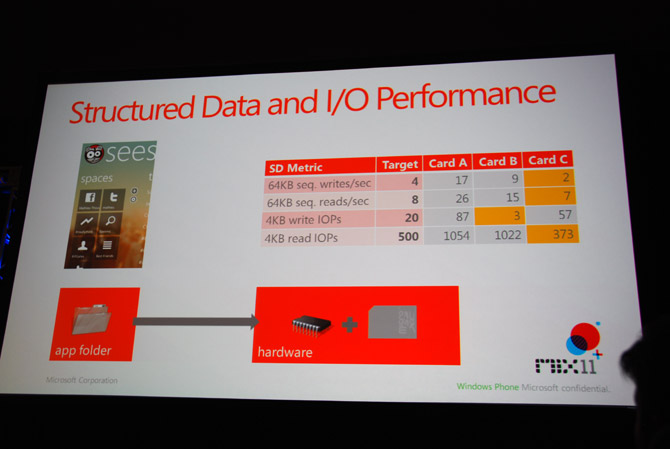
The first was the scope of input & output performance discrepancy for SD cards inside Windows Phone 7s. As I understood it, this affects even “approved” cards that ship with the device. Although it wasn’t clear if these synthetic benchmarks translate to much real-world performance, I assume this explains some of the minor performance inconsistencies between devices.

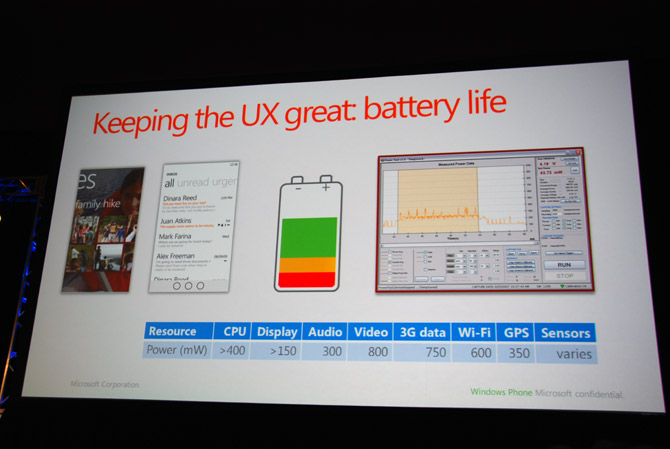
Next was a break-down of the battery usage by component on the device. Even though it wasn’t a secret video decoding, 3G and WiFi are some of the biggest consumers of battery power, the numbers reveals exactly how much difference there is between the each of them. As a surprise to me, neither the GPS or display consumed as much power as I thought they did.

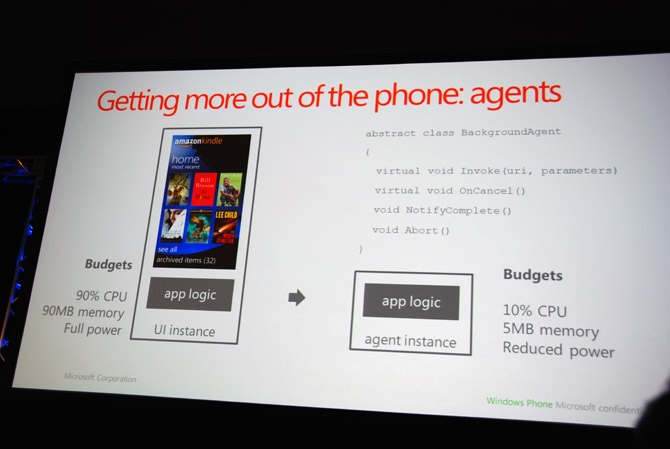
Finally, just as foreground applications on Windows Phone 7 have resource budgets limited by the operating system, background agents do too. It turns out in normal situations, live agents have a maximum allocation of 10% CPU and 5MB of memory which may be a conservative limit that I’m not sure if developers will hit if they try to do anything more than simple web requests. We’ll have to see I guess.

Qantas app flies us to “2019” with Mango WP7 app

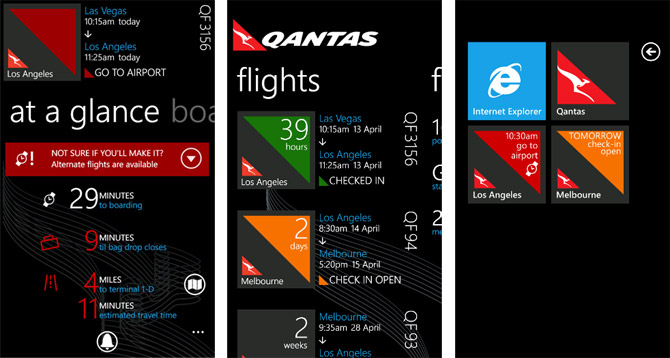
At the second MIX11 keynote today, there was no better demonstration of a slice of Windows Phone 7’s evolved “Mango” update features for developers and consumers than the upcoming Qantas application.

The Australian airline, who didn’t just want a port of their mobile site, in collaboration with Microsoft challenged themselves to reduce the stress of flying with an experience that looks like something out of a sci-fi movie, with glaring similarities to the idealistic “2019” Microsoft vision video.

Developed by local Australian mobile developer Nick Randolph and designer Shane Morris, collaborating remotely across Sydney and Melbourne, the application seen today came together in a matter of just barely three weeks.

The application shines with an array of new Mango features including but not limited to, multiple tiles, double-sided tiles, live agents, deep linking, native alerts and a Bing Maps direction launcher. Expect even more Mango features to be integrated into the application before its release.

Looking back at the 2019 video, it doesn’t take a genius to figure out that the interactive boarding card is a not too distant future with the Qantas app adapting to whether or not you are at the airport, even providing you an easy way to reschedule the flight if it anticipates you can’t check-in in time.

As a frequent flyer of Qantas on the very route demoed, neither Mango or this app can come soon enough.

Behind the World’s Biggest Pac-Man

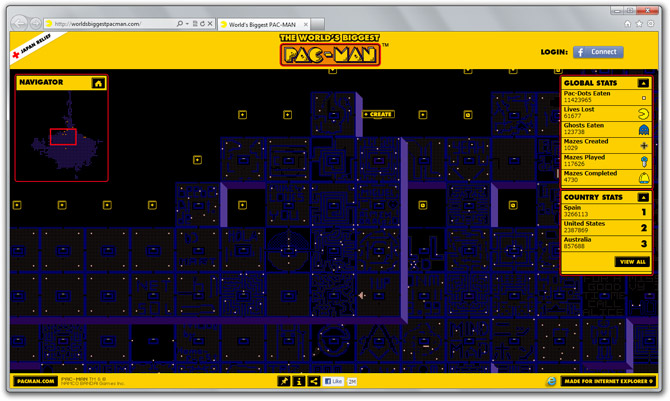
It’s only been a day since Microsoft announced The World’s Biggest Pac-Man game at the MIX11 conference as a HTML5 demonstration, but nostalgia has fueled more than 118,000 plays with gamers eating more than 11 million dots. Watch out Minecraft.

Adding a new layer to the classic, the website allows users to build and submit custom Pac-Man levels in a shared community that has inspired some interesting and fun designs. Over 1000 mazes have been submitted already.

I had the chance to ask some simple questions to Ashley Ringrose of Soap Creative, the Australian developers who collaborated with Microsoft and NAMCO BANDAI to bring this iconic game with 30 years history back to life in the browser without a plugin.

How long did this take to build?

6 weeks to build although this included many late nights and a long weekend.

Hardest part of the project?

While it seems simple we had a lot of challenges. Browsing, creating and playing the mazes were all like separate little projects, each worked on by a different developer. Tying them together in a simple and fun user experience was tough as was working in HTML5 and optimising for all the various browsers. You don’t have the history or community to call on for bugs fixes.

Best part?

Working on a project of this size and with a brand like PAC-MAN was a joy. Everyone believed in it from the start and it was hard for us to stop ourselves wanting to add more features and more ideas.

Working in HTML5 was fun in a way. We went out of our comfort zone and learned a lot in the process. Local storage, WOFF, sounds, canvas, canvas exporting data and even some tricks on how to cache audio all were learned from scratch over the dev period.

We’ll also be doing an indepth session on this project at ReMIX11 in Sydney in June.

MIX11 group liveblog: day 2 keynote

Hi, welcome to day 1 of the MIX11 keynotes group liveblog with Ed Bott, Mary Jo Foley, Kip Kniskern, Rafael Rivera, Bob Stein, Paul Thurrott and I.

Today’s keynoters are Joe Belfiore, Microsoft corporate vice president for Windows Phone, and Scott Guthrie, corporate vice president for .NET developer platform, and the keynote is supposed to be largely focused on Windows Phone 7 and even a taste of the Kinect SDK.